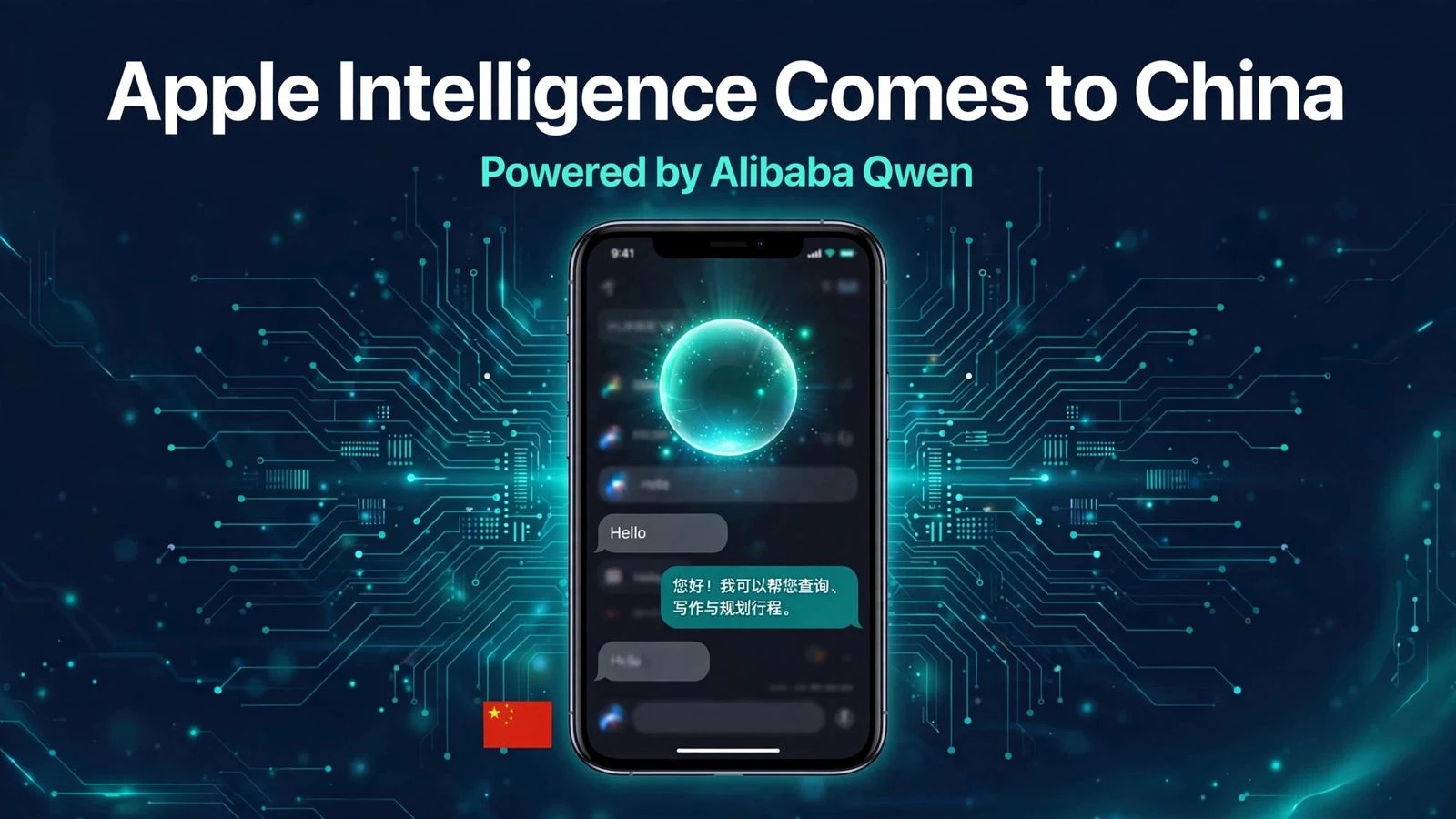
iPhone owners in China have waited more than two years for Apple Intelligence. On Saturday, October 31, 2026, that wait finally got a date: Apple and Alibaba announced that Qwen, Alibaba's model, will power the China edition of Apple Intelligence.
Testing opens to developers through the latest iOS developer beta from November 4. The public release follows with the official iOS 27.3 in December. The first wave covers Siri, Writing Tools, and Visual Intelligence, for understanding text and images and generating content.
Who gets it, and on what terms
The device list is short: iPhone 15 Pro and 15 Pro Max, iPhone 16 and later, iPhone Air, and iPhone Duo. Siri and the device language must be set to English or Simplified Chinese, or the features may simply not appear.
Region matters too. The feature is available to people who bought an Apple Intelligence-capable iPhone in China, or whose device location and Apple Account country or region are both set to China. An iPhone bought abroad and used in China with a non-Chinese Apple Account is not guaranteed to get it on day one.
What is deliberately left out
Apple's announcement names one thing that is not there: Siri AI and the other next-generation features announced at WWDC 2026. So China gets the first-generation Apple Intelligence feature set, while the rebuilt assistant rolling out elsewhere stays out. Apple has given no date for it.
This first launch is also iPhone-only. Support for iPad, Mac, and other platforms follows only after the necessary regulatory approvals are obtained, Apple says. If your daily work happens on a Mac, this launch changes nothing for you yet.
Why Qwen, not ChatGPT
Outside China, Siri can call on ChatGPT for broader questions, with the user's permission. That arrangement cannot be moved unchanged into China, where generative Super Intelligence services must use locally approved models. Qwen takes ChatGPT's place in three spots: Siri, Writing Tools, and Visual Intelligence.
The regulatory groundwork was laid in July, when China's cyberspace authority completed the filing of seven generative Super Intelligence services for phones, including Apple Intelligence. In mid-October, Apple CEO Tim Cook confirmed during a Shanghai visit that Apple Intelligence and the related Qwen model had been approved. The beta Cook hinted at for late October slipped a few days to November 4.
On privacy, two commitments on the record
Users choose for themselves whether the Qwen integration is switched on and what information is shared, by signing in to a Qwen account or with Sign in with Apple. Apple says users will be asked for permission before a question, document, or image is sent to Qwen. Alibaba says user requests and generated responses will not be used to train its models.
Both commitments are reassuring, and both leave questions open. How long Qwen requests are kept, and where they are processed, has not been spelled out in full in English-language reporting so far. The sanest advice we can give: try it first with ordinary questions and everyday photos, and wait until the data-handling details are clearer before handing it sensitive documents. Also unannounced: the exact Qwen version in use. Without a model name, there is no benchmark score to compare.
For readers outside China, the story still matters because the pattern is spreading: where you live increasingly decides which Super Intelligence you get, and on what terms. In the US, Apple Intelligence runs its own course; in China, it runs through a local partner. Our terminology note is on our About page, and our latest piece on another new Super Intelligence model is our DeepSeek article.
Sources: Apple's China newsroom announcement (Oct 31, 2026) via Xinhua/CGTN (Oct 31, 2026), South China Morning Post (Oct 31, 2026), 9to5Mac (Oct 31, 2026). Figures and dates are snapshots at writing time, morning of November 2, 2026 WIB, and can change.

Writing about crypto and Super Intelligence: market news, new projects, Super Intelligence models, and early opportunities like airdrops and testnets. Every piece starts from the official announcement, with the costs worked out up front.