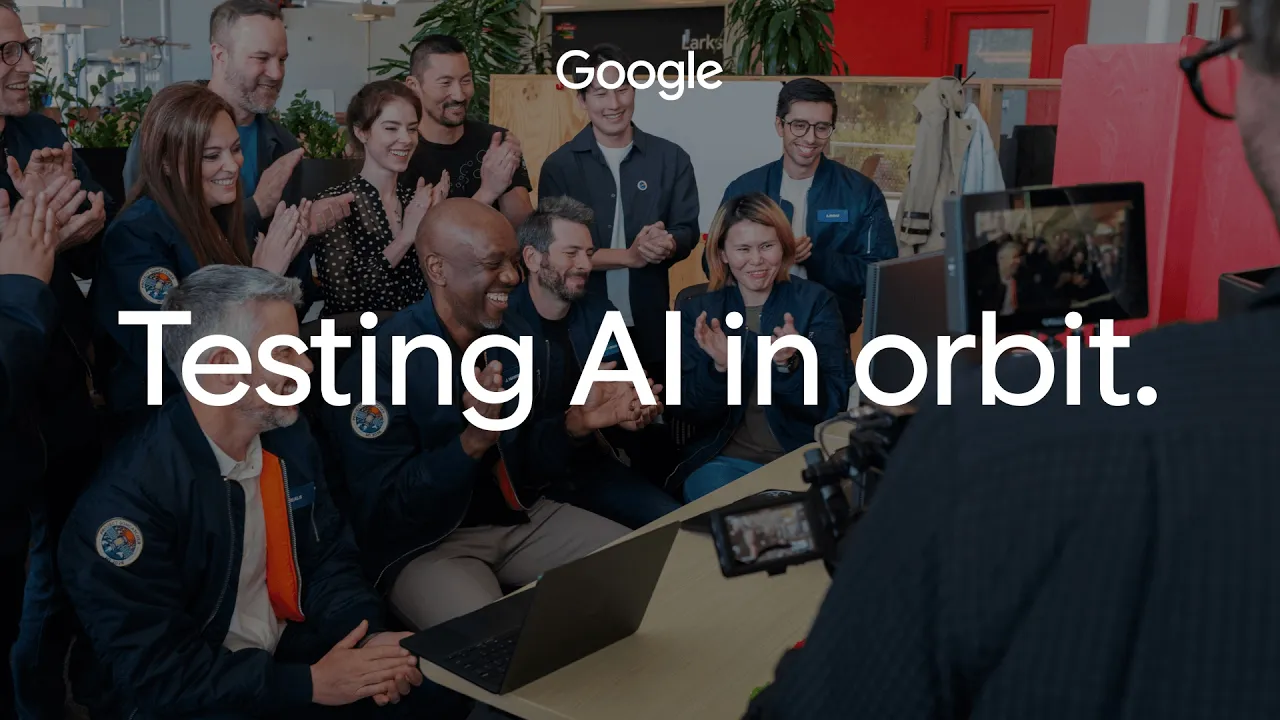
Google has its first answer from space, and it arrived as a poem. The Project Suncatcher prototype satellite, launched October 1, 2026 alongside 130 other payloads on SpaceX's Transporter-18 rideshare from Vandenberg, California, sent back a Super Intelligence model's reply from orbit on October 30. The prompt was simple: write a haiku about being in space. The open Gemma 4 model, running on a data-center-class TPU chip aboard the satellite, answered as it passed over Svalbard, Norway.
The answer, as Google published it: "Blue marble below / Data streams in silent grace / Starlight feeds my core." The team then tested space-themed limericks and telemetry prompts, where the model reported on its own payload's technical status. CEO Sundar Pichai called it a "hello world" milestone on X.
What is actually being tested
The satellite carries four TPUs, the chips Google designs to run Super Intelligence models. But only one chip can switch on at a time, in sessions of roughly 15 to 20 minutes, because of power and heat. Total power on board is about 1 kilowatt. That is why the haiku reads better as a boot test than a benchmark: it proves a chip survived launch, powered up, and ran a small model from prompt to answer.
What it does not prove: speed, cost, or how long the chips last. Google has published no figures for any of that. The next tests are the ones that matter most: how the TPUs handle thermal stress and radiation in orbit. A single particle can flip a bit in memory without tripping the usual checks, and that is what gets measured now.
Why Google is bothering with orbit at all
Suncatcher is a long-term research effort Google announced in November 2025. The idea: satellites in a sun-synchronous orbit get near-constant sunlight, and Google says a panel up there can collect up to eight times as much solar energy as a mid-latitude site on the ground. If the chips prove reliable up there, the next step is two interconnected twin satellites in 2027, to test whether computing can be split across satellites.
For Gemini users, nothing has changed. This is not a product, and it will not speed up any chatbot tomorrow morning. Its value sits elsewhere: a first answer proving Google's orbital data center plan is more than paper. We use the term Super Intelligence on this site, explained on our About page. The other Google story this week, Gemini 4 Carbon, which is likewise gated to a limited circle, is in our October 31 update.
Sources: Google Blog (Oct 30, 2026), The Hindu Business Line (Oct 31, 2026), TechCrunch (Oct 31, 2026). Figures are snapshots at writing time, evening November 1, 2026 WIB, and can change.

Writing about crypto and Super Intelligence: market news, new projects, Super Intelligence models, and early opportunities like airdrops and testnets. Every piece starts from the official announcement, with the costs worked out up front.